


Does Anticipated Racist Abuse Change the Psychology of Penalty Taking?
Updated: Jun 3

Every penalty carries consequences. Some are obvious: letting your team down, losing a final, or facing criticism from fans, teammates, and the media. Others may be less obvious, extending beyond football itself.
Following Arsenal’s defeat to Paris Saint-Germain in the Champions League final, I found myself reflecting on the psychology of penalty shootouts. Gabriel and Eze’s missed penalties led me to a broader question: if pressure is influenced by the consequences attached to success and failure, what happens when the consequences of failure extend beyond football itself?
Following England’s defeat in the Euro 2020 final, Bukayo Saka, Marcus Rashford, and Jadon Sancho were subjected to widespread racist abuse after missing penalties. Their experiences raise an interesting question about the psychology of pressure. Could the possibility of racist abuse add an additional layer of pressure for some players stepping up to take a penalty?
In this article, I’ll explore what we know about pressure, challenge and threat states, and the psychology of anticipated discrimination, before considering whether these factors might intersect in one of football’s most demanding moments.
What penalty research tells us about pressure
Before exploring whether fear of racist abuse could influence penalty taking, it’s worth establishing something more basic: pressure affects performance.
One of the clearest examples comes from penalty shootouts. Although the task remains the same, penalties are converted less frequently in shootouts than during normal match play, suggesting that the additional pressure attached to the moment may influence performance (Vollmer et al., 2024).
Research has also found that pressure affects more than just the outcome of a penalty. Under greater pressure, players are more likely to display avoidance behaviours before taking the kick, such as looking away from the goalkeeper, rushing their preparation, or beginning their run-up more quickly after the referee’s whistle. These behaviours have all been linked with lower penalty success (Jordet & Hartman, 2008; Jordet et al., 2009). One explanation is that, rather than fully engaging with the situation, some players may be trying to get the moment over with as quickly as possible.
These findings suggest that pressure is not just something athletes feel. It can influence how they respond to the situation itself, ultimately affecting performance. An important question, then, is why some athletes experience pressure differently from others in the same situation.
Challenge & Threat States
One theory that may help explain these findings is the Theory of Challenge and Threat States in Athletes (Jones et al., 2009). Rather than viewing pressure as something that automatically harms performance, the theory suggests that what matters is how athletes evaluate the demands of a situation and their ability to cope with those demands.
When athletes believe they can cope with those demands, they are more likely to experience a challenge state. When the demands of the situation appear greater than their perceived ability to cope, they are more likely to experience a threat state. Importantly, these evaluations are not determined by the situation itself. The same penalty can feel like a challenge to one player and a threat to another.

Part of this evaluation involves the perceived consequences of success and failure. The greater the perceived cost of failure, the more demanding a situation may feel. A player taking a penalty is not simply evaluating their ability to strike a ball into the net; they may also be thinking about letting teammates down, losing a trophy, facing criticism from fans and the media, or dealing with the personal disappointment that follows a miss.
From this perspective, penalties become more than technical tasks. They are situations in which players are constantly evaluating what is at stake and whether they believe they can cope with the demands of the moment.
Beyond the penalty: the psychological anticipation of discrimination
So how does perceived racism play a part?
Individuals who anticipate prejudice are more likely to experience increased stress and vigilance, often becoming more aware of potential threats within their environment (Major et al., 2007). Research has also shown that discrimination, and the expectation of discrimination, are associated with elevated stress responses (Pascoe & Smart Richman, 2009). The anticipation of being treated unfairly can itself be psychologically demanding.
One explanation comes from research on stereotype threat. Concerns about being judged can occupy mental resources that would otherwise be available for performance, potentially making it more difficult to execute a skill effectively (Schmader et al., 2008).
Taken together, these findings suggest that anticipated discrimination is more than an unpleasant possibility. Research indicates that it can create additional psychological demands before a performance even begins. If challenge and threat states are influenced by how athletes evaluate the demands of a situation, then anticipated discrimination may be relevant. By increasing stress, vigilance, and cognitive load, it could make a situation feel more demanding and therefore more likely to be experienced as a threat rather than a challenge.
The Euro 2020 Example
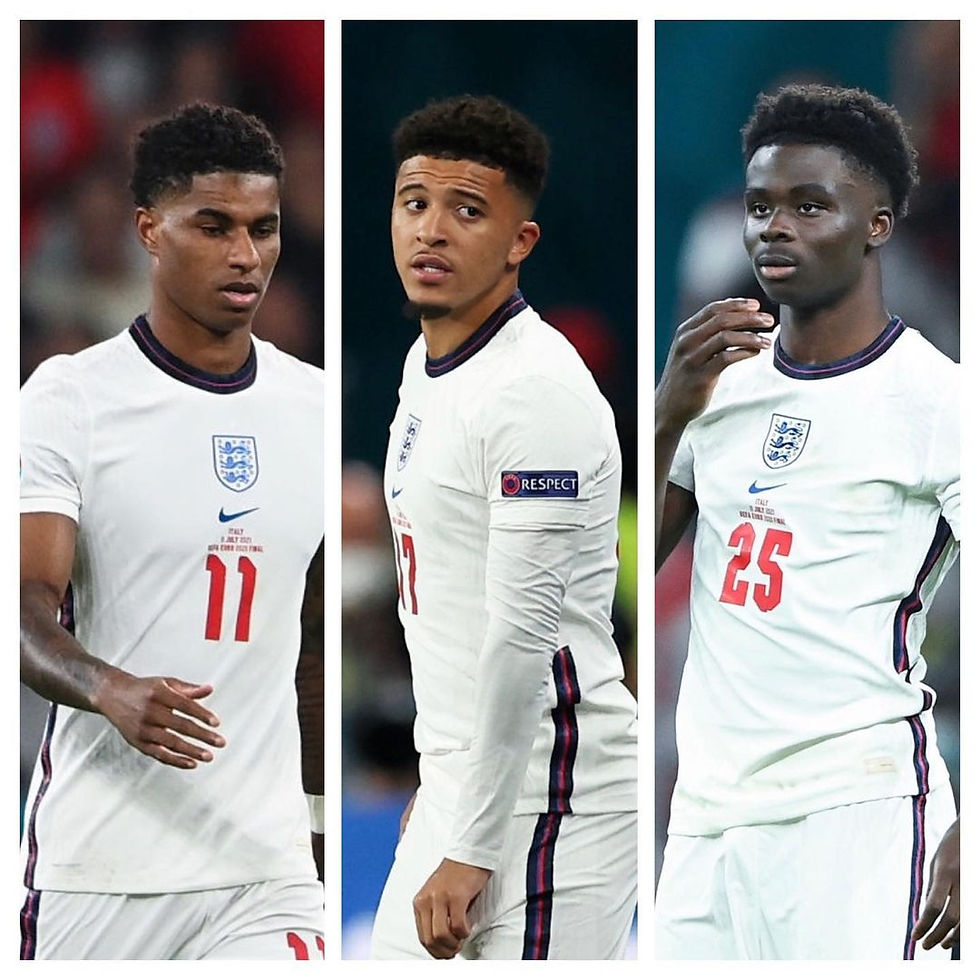
Following England’s defeat in the Euro 2020 final, Bukayo Saka, Marcus Rashford, and Jadon Sancho were subjected to widespread racist abuse after missing penalties in the shootout.
The significance of incidents such as Euro 2020 is not simply that they demonstrate racism exists within football. They also provide a highly visible example of what can follow failure. As a result, many players will be aware that, in some cases, the fallout from a missed penalty can extend beyond criticism of their performance and into discriminatory abuse.
Based on the research discussed above, previous incidents of racist abuse may represent an additional factor that some players have to consider when stepping up to take a penalty, potentially increasing the psychological burden of the task.
This does not tell us whether performance will be affected. However, it does suggest that some athletes may be evaluating a different set of consequences when they stand over the ball.
An unanswered question: does fear of racist abuse change the psychology of penalty taking?
The purpose of this article has been to explore whether some players may experience additional psychological demands when stepping up to take a penalty.
If anticipated discrimination increases the perceived demands of a situation, then it is reasonable to ask whether the possibility of racist abuse could contribute to a threat appraisal. By increasing the perceived cost of failure, the research reviewed here suggests that the possibility of racist abuse may add to the demands of the situation and, for some athletes, increase the likelihood that those demands outweigh their perceived resources. In turn, this may increase the likelihood of the situation being experienced as a threat rather than a challenge.
Whether that changes performance remains unknown. However, it raises an important question: does the possibility of racist abuse change the psychology of penalty taking?
References:
Jordet, G., & Hartman, E. (2008). Avoidance motivation and choking under pressure in soccer penalty shootouts. Journal of Sport and Exercise Psychology, 30(4), 450-457.
Jordet, G., Hartman, E., & Sigmundstad, E. (2009). Temporal links to performing under pressure in international soccer penalty shootouts. Psychology of Sport and Exercise, 10(6), 621-627.
Major, B., Kaiser, C. R., O’Brien, L. T., & McCoy, S. K. (2007). Perceived discrimination as worldview threat or worldview confirmation: Implications for self-esteem. Journal of Personality and Social Psychology, 92(6), 1068.
Meijen, C., Turner, M., Jones, M. V., Sheffield, D., & McCarthy, P. (2020). A theory of challenge and threat states in athletes: A revised conceptualization. Frontiers in Psychology, 11, 126.
Pascoe, E. A., & Smart Richman, L. (2009). Perceived discrimination and health: A meta-analytic review. Psychological Bulletin, 135(4), 531.
Schmader, T., Johns, M., & Forbes, C. (2008). An integrated process model of stereotype threat effects on performance. Psychological Review, 115(2), 336.
Vollmer, S., Schoch, D., & Brandes, U. (2024). Penalty shoot-outs are tough, but the alternating order is fair. PLOS ONE, 19(12), e0315017.


Comments